Mike Gauthier
02.24.2026
Summary
Contamination doesn’t take breaks, and neither should your filtration strategy. This article explains why continuous wall mount filtration is a practical, cost-effective way to maintain oil cleanliness in critical assets, bulk storage, and contamination-heavy environments. By keeping fluid conditioned around the clock, teams can extend oil life, reduce downtime, and turn contamination control into a permanent reliability advantage.
Why Continuous Wall Mount Filtration Belongs in Your Oil Contamination Control Strategy
Contamination is the silent enemy in industrial lube systems. It accelerates wear, drives unplanned downtime, and undermines reliability targets. Periodic filtration and sampling are valuable steps, but for many assets there is a stronger solution: continuous wall mount filtration. These systems provide ongoing fluid conditioning, bringing real operational value where it matters most.
When Continuous Filtration Is the Right Strategy
Many assets face contamination challenges that neither batch filtration nor routine sampling can fully address. Consider:
- Gearboxes with high particle generation or aspiration rates
- Hydraulic power units with tight tolerances and servo valves
- Bulk oil storage where oils feed multiple assets
- Fluid in remote or contaminate-rich environments such as steel mills, mining, pulp and paper, cement, or outdoor lube rooms
Cleanliness Is Key to Reliability
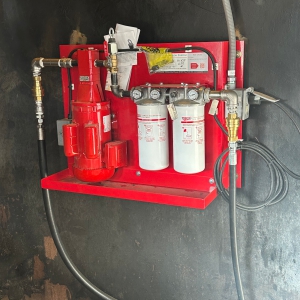 Every reliability professional knows that fluid cleanliness targets are not an aspiration. They are a maintenance priority. Continuous wall mount filtration delivers sustained reduction in particle counts and water levels, supporting:
- Improved wear control
- Reduced valve and servo sticking in hydraulics
- Longer oil life and extended drain intervals
- Higher uptime and lower maintenance costs
Versatility Across Your Lubricant Ecosystem
Continuous filtration is not reserved for in-service reservoirs alone. The right system adapts to multiple use cases:
- Wall mount filtration for gearboxes, hydraulic units, and bulk oil systems
- Pre-condition new oil in drums, totes, and tanks before it enters critical assets
- Use in lube rooms where oils are staged prior to distribution
Periodic vs. Permanent Filtration
Periodic filtration, using filter carts or offline systems, is effective at reducing contamination at the time of service. However, without a permanent filtration strategy, contamination levels rise again as soon as the cart is removed. Continuous wall mount filtration maintains targeted contamination levels automatically, without repeated labor or process interruptions. For critical systems that demand consistent fluid quality, permanent filtration is the ideal. There is also a clear financial case. Consider a gearbox holding 60 gallons of oil. A single oil change can cost approximately 3,000 to 4,000 dollars when lubricant purchase, handling, disposal, and labor are factored in. Avoiding just one oil change through effective contamination control can pay for the wall mount filtration unit. Beyond that point, the return shifts from cost recovery to sustained savings, reduced waste generation, and improved asset reliability.
Addressing Remote and Contamination-Rich Locations
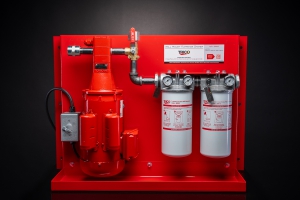 Assets in remote plant zones, outdoors, or near dust, water, and particulate sources face a higher contamination burden. Industries such as mining, pulp and paper, cement, and steel processing operate in environments where airborne particulate and moisture intrusion are constant threats. These areas often receive less frequent proactive attention due to access and staffing constraints. A wall mount filtration unit delivers continuous protection with minimal intervention, improving reliability where maintenance resources are limited.
Sizing and Selection: Two Units for Flexible Flow Rates
Effective continuous filtration starts with matching flow to reservoir size and contamination load. That’s why having options matters. For example:
- A smaller unit for individual gearboxes or discrete hydraulic systems
- A larger unit for bulk oil tanks, central lube systems, or larger reservoirs
| Model | Description | Motor | Flow Rate |
|---|---|---|---|
| 37002 | Large Wall Mount Filtration System | 1-1/2 HP @ 1750 RPM | 4.0 GPM |
| 37003 | Small Wall Mount Filtration System | 3/4 HP @ 1750 RPM | 1.0 GPM |
Make it a Permanent Strategy
Continuous wall mount filtration should be a key component of any contamination control strategy. By keeping fluid clean around the clock, these systems enhance asset reliability, reduce maintenance workload, and extend oil life. Whether conditioning oil before service or protecting critical in-service reservoirs, continuous filtration delivers measurable value in environments where downtime is not an option. Category:
Tags: