Lisa Kiepert
08.11.2026
Summary
Maintenance wants to improve reliability, but many struggle to justify relatively small investments in lubrication while routinely approving much larger repair costs after equipment fails. The problem isn't that lubrication lacks value, it's that most organizations measure the cost of prevention without fully understanding the cost of failure. This article explores why that happens and provides a framework for building a business case for proactive lubrication.
Making the case for preventive maintenance investments
Every maintenance professional has experienced some version of this conversation.
"We'd like to install desiccant breathers on our critical gearboxes."
"Can we wait until next year's budget?"
"We should begin filtering new oil before it enters our hydraulic systems."
"Let's revisit it later."
"We'd like to expand oil analysis on our critical assets."
"We'll have to see if there's room in the budget."
Then something fails. The gearbox is replaced. Emergency freight is approved. Contractors are called in. Production is interrupted. Overtime is authorized. No one questions the repair bill. The difference isn't the cost. It's when the money is spent. Organizations often find it easier to approve the cost of failure than the cost of preventing it. That's one of the biggest challenges facing lubrication and reliability programs today.
We're Asking the Wrong Budget Question
Most lubrication improvements are evaluated with a simple question: "How much will this cost?" That's understandable. Every purchase request has a price attached to it. But it's only half of the equation. The more important question is: What will it cost if we don't do this? That's a much harder number to calculate. And because it's harder to calculate, it often gets ignored.
A Different Way to Think About ROI
Instead of comparing the price of a lubrication improvement to the maintenance budget, compare it to the cost of one failure.Consider a critical gearbox.
What Does Prevention Cost?
| Preventive Investment | Typical Cost |
|---|---|
| Desiccant breather | $200–$400 |
| Dedicated transfer container | $150–$300 |
| Filtering new oil | <$500 |
| Annual oil analysis | A few hundred dollars |
The better comparison: Evaluate preventive spending against the potential cost of a failure—not simply against the maintenance budget.
What Does One Failure Really Cost?
| Failure Cost | Typical Impact |
|---|---|
| Replacement gearbox | Thousands to tens of thousands of dollars |
| Labor | Planned or emergency maintenance |
| Production downtime | Hours or days of lost output |
| Expedited shipping | Premium freight charges |
| Overtime | Nights and weekends |
| Restart and verification | Additional labor and lost production |
The real comparison: The replacement component is only part of the cost. Labor, downtime, freight, overtime, and restart activities can quickly turn one equipment failure into a much larger business expense.
Key Takeaway
Don't compare a $300 breather to a $300 budget line. Compare it to the failure it's intended to help prevent.
The Hidden Accounting Problem
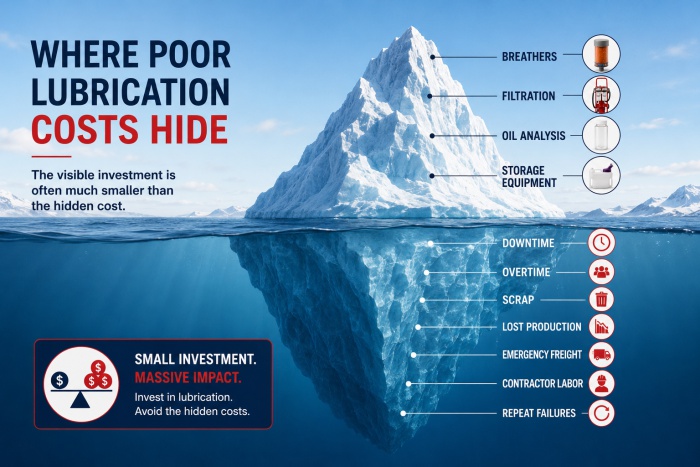
Poor lubrication rarely appears as a lubrication expense. Instead, its costs are scattered throughout the organization.
Where Do Poor Lubrication Costs Actually Show Up?
| Department | Where the Cost Appears |
|---|---|
| Maintenance | Equipment repairs |
| Operations | Lost production |
| Purchasing | Expedited freight |
| Reliability | Failure investigations |
| Inventory | Spare parts |
| Finance | Higher operating costs |
Why this matters: Poor lubrication rarely appears as a single lubrication expense. Its financial impact is spread across departments, which can make the true cost much harder to see.
Prevention Doesn't Generate Invoices
Imagine opening your inbox on Monday morning.You might find invoices for:
- Replacement bearings
- Emergency contractor labor
- Overnight freight
- Crane rentals
- Replacement oil
- Production losses
Bearing failure prevented: $0
Or:
Emergency shutdown avoided: $0
That's the challenge. Preventive maintenance succeeds by making problems disappear. And it's surprisingly difficult to assign value to something that never happened.
What Research Tells Us
Industry research consistently shows that contamination is one of the leading causes of lubricant-related equipment failures. Likewise, organizations such as the International Council for Machinery Lubrication (ICML) emphasize contamination control, proper storage, filtration, and representative oil sampling as foundational best practices because they address failure mechanisms before damage begins.Another important point is that new lubricant isn't necessarily clean lubricant. Depending on how it's manufactured, transported, and stored, fresh oil may require filtration before it meets the cleanliness targets of critical hydraulic and circulating systems.
These findings reinforce an important idea. Lubrication isn't simply about adding oil. It's about managing lubricant health from storage through disposal.
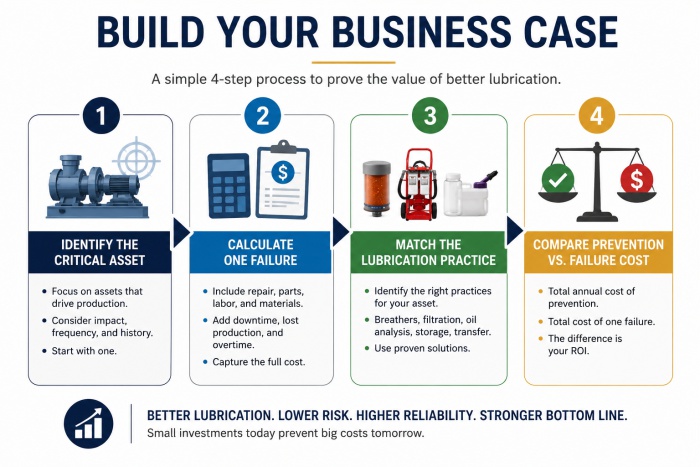
A Simple Framework for Building the Business Case
When requesting funding for lubrication improvements, avoid leading with products. Instead, work through four questions.1. Which asset creates the greatest business risk?
Focus on assets where failure has the highest operational impact.
2. What would one failure actually cost?
Look beyond replacement parts.
Include labor, lost production, emergency shipping, contractor support, environmental cleanup, and startup activities.
3. Which lubrication practice reduces that specific risk?
Examples include contamination control, filtration, oil analysis, improved storage, or better transfer practices.
4. Is the preventive investment smaller than the potential loss?
In many cases, the answer becomes obvious once the true cost of failure is understood.
Measure What Matters
Many lubrication programs track activities.- Gallons of oil used
- PMs completed
- Samples collected
Examples include:
- Improved ISO cleanliness codes
- Extended lubricant life
- Reduced emergency work orders
- Fewer repeat failures
- Increased Mean Time Between Failures (MTBF)
- Reduced maintenance cost per asset
The Best Reliability Investments Are Quiet
The most successful lubrication programs rarely make headlines. Machines simply keep running. Failures become less frequent. Emergency work declines. Production becomes more predictable. In many ways, the best lubrication program is the one nobody notices because the equipment continues doing exactly what it's supposed to do.That's why lubrication deserves more than a maintenance budget. It deserves a place in every reliability strategy. The next time a lubrication improvement is proposed, don't start by asking:
"How much does it cost?"
Instead ask:
"What will poor lubrication cost us if we do nothing?"
That single question often changes the entire conversation.
Key Takeaways
- Evaluate lubrication investments against the cost of failure—not just the purchase price.
- Poor lubrication costs are often hidden across multiple departments.
- Prevention is difficult to measure because successful prevention produces no invoice.
- Strong business cases connect lubrication improvements to risk reduction and measurable business outcomes.
- The most effective lubrication programs become nearly invisible because failures become less common.
Category:
Tags: