Lisa Kiepert
10.13.2026
Summary
Improving a lubrication program can feel overwhelming when storage, transfer, equipment, sampling, oil analysis, procedures, and training all need attention. Instead of trying to address everything at once, start by understanding where the greatest risks and inconsistencies exist, make targeted improvements, and use the results to determine what comes next.
A Practical Approach to Deciding What to Improve First and What Should Come Next
You start looking at lubricant storage and notice problems with identification. Then you look at transfer practices. Sampling points need attention. Some equipment needs better contamination control. Oil analysis results aren't always leading to action. Procedures aren't consistent. Training could be improved.Before long, what started as an effort to improve lubrication looks like a facility-wide project involving equipment, people, processes, products, training, and budget.
That can make it difficult to know where to begin.
The answer usually isn't to fix everything at once. It's to understand where you are today, identify what deserves attention first, make deliberate improvements, and use what you learn to determine what comes next.
Start by Understanding the Current State
Before deciding what to change, understand what is already happening.A useful way to do that is to follow the Journey of the Lubricant through the facility:
Arrival → Storage → Transfer → Application → Lifecycle
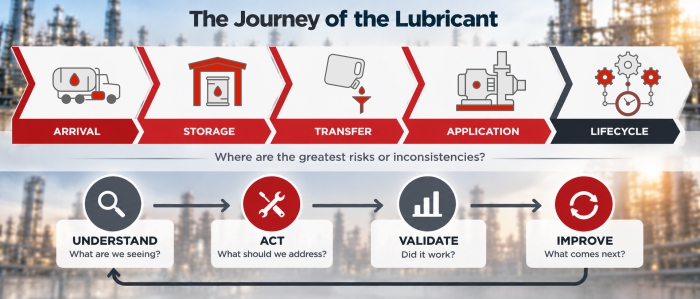
Look at how lubricants are received and identified. Examine where and how they're stored. Follow how they're transferred to equipment. Look at how they're applied and how equipment is protected. Then consider how lubricant and equipment condition are monitored once the machine is operating.
The purpose isn't to create a long list of everything that's wrong.
It's to identify where inconsistent practices, contamination risks, equipment conditions, or information gaps may be affecting reliability.
Not Every Gap Has the Same Priority
Once you start looking, you'll probably find more than one opportunity.That doesn't mean they all deserve the same attention.
A mislabeled transfer container and recurring water contamination in a critical gearbox are both lubrication issues, but they don't carry the same risk.
Prioritization should consider factors such as equipment criticality, likelihood and consequence of failure, frequency of the problem, current lubricant or equipment condition, and whether the issue affects multiple assets or processes.
Sometimes a relatively simple improvement can also remove a recurring source of problems across the facility.
For example, improving lubricant identification may reduce misapplication risk at multiple machines. Establishing dedicated transfer containers can help reduce cross-contamination. Installing appropriate sampling hardware can make future oil samples more consistent and representative.
The question isn't simply: What could we improve?
A more useful question is: What should we improve first, and why?
Look for the Connections
Lubrication problems don't always stay within one stage of the process.Contamination found inside equipment may have entered during storage or transfer. An unusual oil analysis result may be related to the lubricant, the machine, operating conditions, or maintenance activity. Repeated top-offs may point to something different than a lubricant problem.
That's why improvements are more effective when they're considered as part of a connected process.
If oil analysis results repeatedly show particulate contamination, for example, filtration may be part of the response but it may not answer where the contamination is entering.
The better question becomes: What is creating the condition we're trying to correct?
That may lead the investigation upstream to storage, transfer practices, maintenance activity, or another part of the lubricant's journey.
Understanding those connections can help keep a facility from repeatedly treating the symptom while leaving the source unchanged.
Start With Improvements You Can Manage
A lubrication improvement plan doesn't have to begin with a major capital project.Depending on what you find, an early action might be:
- standardizing a procedure
- correcting lubricant identification
- establishing dedicated transfer equipment
- improving a sampling location
- addressing a contamination entry point
- changing a filtration practice
- training personnel on a recurring issue
- establishing baseline oil analysis or equipment condition data
The important part is that the action responds to something you actually identified.
The right action isn't always a product.
Sometimes the most useful first improvement is simply creating consistency in a process that hasn't been consistent before.
Know What You Expect to Change
This is where lubrication improvement can become much more useful.Before making a change, ask: What should look different if this works?
If you improve contamination control, perhaps you expect particle counts or moisture levels to improve.
If you change a sampling procedure, you may expect more consistent trend data.
If you address an equipment condition, you may be watching oil analysis results, vibration, temperature, lubricant consumption, maintenance activity, or another relevant indicator.
If you reorganize lubricant storage and identification, success may initially be procedural: fewer opportunities for cross-contamination or misapplication and a more consistent transfer process.
The measure doesn't have to be complicated.
It just needs to help answer whether the change made the difference you expected.
Validate Before Moving On
Making an improvement isn't the end of the process.Look at what happened afterward.
- Did the condition improve?
- Did it stay the same?
- Did something unexpected change?
If the result improved, you now have evidence that the action was useful and potentially something that can be applied elsewhere.
If it didn't, that's useful information too. It may mean the original assumption wasn't correct, another condition is contributing to the problem, or a different action is needed.
Either way, you've learned something.
That creates a much more practical improvement cycle:
Understand → Act → Validate → Improve
Rather than launching a large program based primarily on assumptions, each step helps inform the next one.
Build the Roadmap From What You Learn
Over time, those individual improvements begin to form a roadmap.Some facilities may discover that lubricant storage and handling need attention first. Others may have strong practices before the lubricant reaches the equipment but lack consistent sampling, analysis, or condition monitoring once it's there.
There isn't one sequence that works for every facility.
A useful roadmap reflects your equipment, operating environment, maintenance practices, available resources, and reliability goals.
And it can change as you learn more.
That's the point.
A lubrication program shouldn't be treated as something you overhaul once and consider finished. It should become a process of understanding what's happening, making informed improvements, and checking whether those improvements are working.
You don't have to change everything at once.
You just need to know where to start and what you're trying to improve.
Not Sure Where to Start?
A Lubrication Management Assessment can help identify gaps, prioritize opportunities, and establish a practical path forward based on your equipment, practices, and reliability goals.Category:
Tags: