Lisa Kiepert
07.28.2026
Summary
Two technicians can perform the same lubrication task in completely different ways and both may believe they're doing it correctly. Without documented procedures, equipment reliability depends on individual habits instead of proven best practices. Standard operating procedures (SOPs) transform lubrication from a collection of personal techniques into a repeatable process that protects equipment, improves consistency, and reduces costly failures.
Consistency Begins with Documented Procedures
Walk through any maintenance shop and ask two experienced technicians how they lubricate the same piece of equipment. You'll probably get two different answers. One fills the reservoir to the top. Another stops halfway. One wipes the grease fitting before connecting the grease gun. Another doesn't. One always checks the breather while adding oil. Another focuses only on the lubricant level.None of these technicians are intentionally doing a poor job. They're following the methods they've learned through years of experience. The problem is that experience isn't always consistent. And inconsistency is one of the biggest enemies of equipment reliability.
Reliability Shouldn't Depend on Who's Working Today
Imagine a critical gearbox that requires lubrication every month. If five technicians perform that task over the course of a year, will every one of them complete it exactly the same way? If the answer is no, then your lubrication program isn't standardized.Many facilities unknowingly rely on tribal knowledge instead of documented processes. Over time, shortcuts develop, assumptions replace best practices, and small differences become accepted as "the way we've always done it." Those small differences eventually become equipment problems.
Small Variations Become Big Problems
Most lubrication failures don't happen because someone forgot to lubricate a machine. They happen because lubrication was performed slightly differently every time. A few common examples include:
- Filling reservoirs to different levels
- Mixing transfer containers between lubricants
- Using different grease quantities
- Forgetting to inspect breathers or seals
- Sampling oil from inconsistent locations
- Skipping contamination control steps during oil transfers
SOPs Create Repeatability
A Standard Operating Procedure (SOP) isn't simply a document stored in a binder. It's a method for ensuring every technician performs the same task the same way, every time. SOPs eliminate guesswork. They define:
- Correct lubricant
- Required tools
- Safety precautions
- Inspection points
- Proper fill levels
- Contamination control practices
- Verification steps
- Documentation requirements
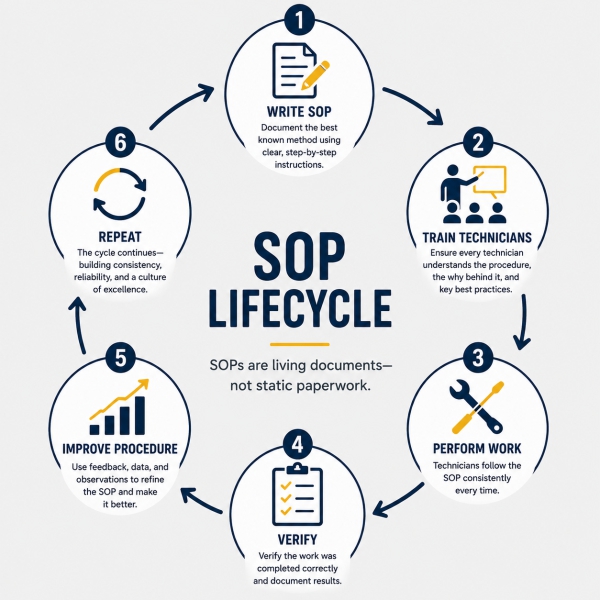
Documentation Improves More Than Maintenance
Written procedures don't just help technicians. They help the entire organization. Engineers gain confidence that maintenance is being performed correctly. Supervisors spend less time correcting inconsistencies. New employees become productive faster. Contractors perform work to the same standards as internal personnel. Root cause investigations become easier because maintenance activities are no longer variables.Instead of asking, "Did everyone lubricate it the same way?" the question becomes, "What changed?" That's a much better place to start an investigation.
What Every Lubrication SOP Should Include
Every lubrication task doesn't require a twenty-page document. In fact, the best SOPs are often simple, visual, and easy to follow. A well-designed lubrication procedure should answer eight questions:1. What equipment is being serviced?
Include equipment identification and location.
2. Which lubricant should be used?
Specify the exact lubricant not just the viscosity or supplier.
3. What tools are required?
Identify transfer containers, grease guns, filtration equipment, sampling hardware, and PPE.
4. How should contamination be prevented?
Include cleaning practices, container requirements, breather inspections, and methods to keep dirt and moisture out during the task.
5. How much lubricant should be added?
Define exact levels, quantities, or visual indicators instead of relying on personal judgment.
6. What inspections should be performed?
Take advantage of the technician already being at the machine.
Look for:
- Leaks
- Damaged breathers
- Foaming oil
- Discoloration
- Low oil levels
- Abnormal temperatures
- Unusual vibration or noise
7. What should be documented?
Maintenance isn't complete until it's recorded.
Capture:
- Date
- Lubricant added
- Quantity
- Observations
- Corrective actions
- Oil sample information when applicable
Verification ensures the procedure was completed correctly and consistently.
The Best SOPs Are Used, Not Filed Away
Many organizations spend months writing procedures that no one ever reads. The most effective SOPs are built for technicians, not auditors.
- They're concise.
- They're visual.
- They include photographs.
- They use color coding.
- They live where the work happens not buried inside a filing cabinet.
Standardization Creates Better Data
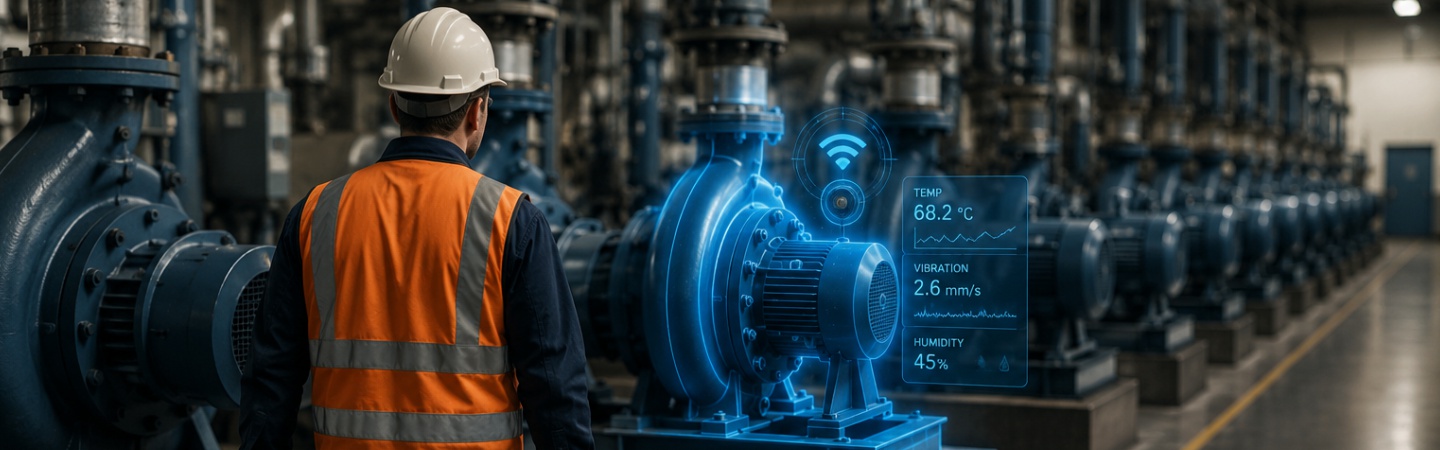
As more facilities adopt condition monitoring and oil analysis, consistency becomes even more important. Sensor data is easier to interpret when lubrication practices remain consistent. Oil analysis trends become more meaningful when samples are collected the same way every time. Maintenance history becomes more valuable because technicians are following the same process instead of individual preferences. Standardized procedures don't just improve maintenance. They improve the quality of every decision that follows.
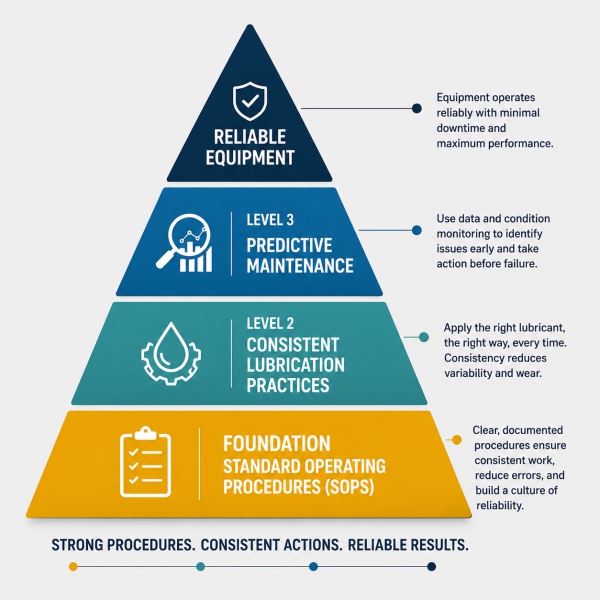
Most Expensive Lubrication Procedure
The best lubrication programs aren't built around the most experienced technician. They're built around the most repeatable process. People retire. Teams change. Contractors come and go. Documented procedures ensure that equipment continues receiving the same level of care regardless of who performs the work.Because in the end, the most expensive lubrication procedure isn't the one that takes too long. It's the one that only exists in someone's memory.
Category:
Tags: