Lisa Kiepert
06.02.2026
Summary
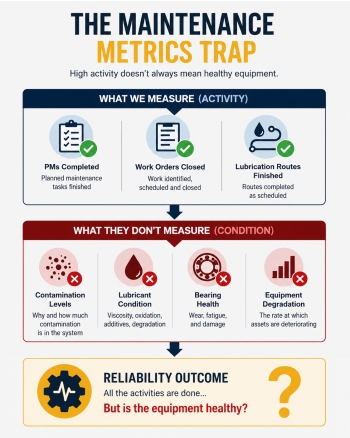
Maintenance teams may be closing work orders and completing lubrication routes on schedule, yet many facilities still struggle with unexpected failures. The issue is not always whether maintenance is being completed, it is whether those activities are improving machine condition.
Rethinking Maintenance KPIs
For decades, preventive maintenance programs have been built around consistency.Tasks are scheduled at fixed intervals. Lubrication routes are completed weekly or monthly. Work orders are tracked and closed. PM completion percentages are reviewed as indicators of maintenance performance.
The assumption has always been straightforward: if maintenance tasks are completed on time, equipment reliability should improve. But many facilities are discovering that high PM compliance does not always translate into reliable equipment operation.
Machines continue to experience premature failures, lubrication-related damage, and unplanned downtime, even in plants with well-documented preventive maintenance programs.
Why Maintenance Compliance Alone Falls Short
 Preventive maintenance schedules are designed around routine activity, but equipment condition does not always follow a predictable calendar. Two identical assets operating in different environments may experience completely different lubrication demands. Factors such as:
- moisture exposure
- production load
- ambient temperature
- contamination levels
- operating speed
- shutdown frequency
As a result, simply completing a lubrication task on schedule does not guarantee the machine received the protection it needed.
A bearing may still fail because:
- the lubricant was contaminated during application
- the wrong grease was used
- lubrication intervals were too long
- excessive grease caused heat buildup
- moisture entered through poorly protected reservoirs
- lubricant condition had already degraded
The Hidden Risks of Routine-Based Maintenance
In some cases, excessive reliance on routine maintenance can unintentionally create new reliability risks. Every time a reservoir is opened, grease fitting accessed, or lubricant transferred, there is an opportunity for contamination to enter the system. Without proper contamination control practices, maintenance activities themselves can contribute to:
- dirt ingress
- moisture contamination
- lubricant cross-contamination
- inconsistent lubricant application
Reliability Requires Verification
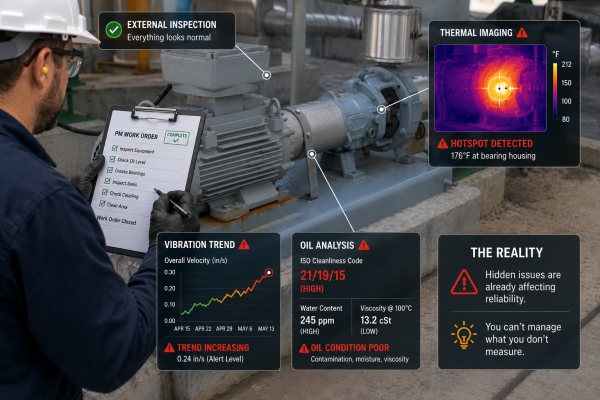
Modern reliability programs are increasingly focused on verifying machine condition rather than simply documenting completed tasks. Instead of asking: “Was the PM completed?”Reliability teams are asking:
- What condition was the lubricant in?
- Were contamination levels controlled?
- Has vibration increased since the last inspection?
- Is operating temperature changing?
- Are lubrication intervals still appropriate for the application?
Technologies such as:
- oil analysis
- condition monitoring
- moisture monitoring
- automatic lubrication systems
- contamination control solutions
Rather than assuming equipment is healthy because maintenance was performed, teams can begin validating actual machine condition.
Measuring What Actually Impacts Reliability
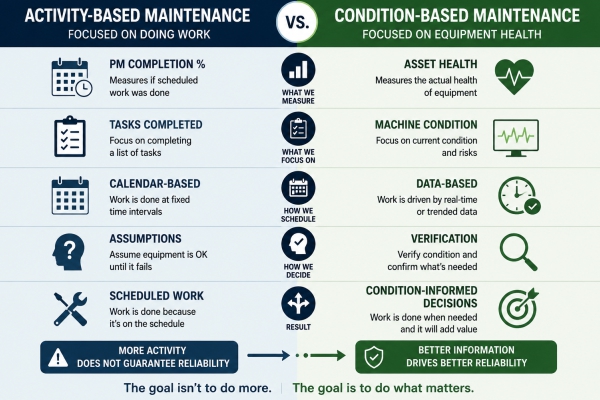
Traditional KPIs still have value. PM completion rates and work order tracking help organizations maintain consistency and accountability. But they should not be mistaken for direct indicators of equipment health.Modern reliability-focused facilities are increasingly tracking metrics such as:
- mean time between failures (MTBF)
- contamination levels
- lubricant condition trends
- equipment availability
- unplanned downtime frequency
- condition monitoring alarms
- asset health scores
The Future of Maintenance Is Precision
The goal of maintenance is not simply completing more tasks. The goal is preserving equipment condition as efficiently and consistently as possible. That requires a shift away from maintenance programs built entirely around routine repetition and toward strategies that combine:- precision lubrication
- contamination control
- condition monitoring
- data-driven maintenance decisions
It is created by maintenance practices that continuously verify and protect machine health over time.
Download the Full Infographics
Want a closer look at the concepts covered in this article?Download the full-size versions of the supporting infographics for use in training sessions, team meetings, maintenance planning discussions, or reliability reviews.
Category:
Tags: