Lisa Kiepert
09.15.2026
Summary
A lubricant can arrive clean, be stored correctly, and still become compromised on its way to the machine. Shared containers, dirty transfer equipment, poor identification, and simple shortcuts can introduce particles or the wrong lubricant before anyone realizes there is a problem.
The Few Minutes That Can Undo Everything
A lot of effort can go into selecting the right lubricant, keeping bulk oil clean, controlling moisture, and maintaining an organized lube room. But there is one part of the process that is easy to overlook: getting that lubricant from storage to the machine.Transfer may only take a few minutes, but it creates plenty of opportunities for contamination.
A container that was used for another lubricant. A funnel sitting uncovered on a shelf. A hose with residual oil from the last transfer. A container that looks clean but isn't.
Each seems minor. Together, they can compromise lubricant cleanliness and, in some cases, introduce an entirely different lubricant into the machine.
Cross-Contamination Is More Than Dirt
When we talk about lubricant contamination, particles and water usually get most of the attention. Cross-contamination is broader.It can occur when a lubricant comes into contact with:
- Another lubricant or viscosity grade
- Residual oil left in transfer equipment
- Cleaning chemicals or other foreign materials
Where Transfer Goes Wrong
Cross-contamination during transfer usually isn't caused by one dramatic mistake. More often, it comes from routine practices that have gradually become normal.
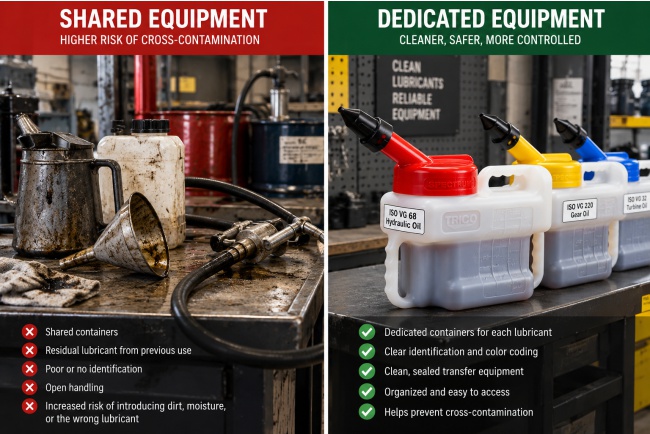
- Shared transfer containers - Using one container for multiple lubricants is one of the easiest ways to introduce the wrong lubricant. Draining the container doesn't necessarily remove the previous lubricant or the residue left on its internal surfaces.
- Dirty pumps, hoses, and dispensing equipment - The container isn't the only concern. Pumps, hoses, wands, funnels, and other equipment that contact the lubricant can carry contamination.
- Poor lubricant identification - Similar-looking containers make mistakes easier. If technicians have to rely on memory, handwriting, or lubricant color alone to determine what belongs where, eventually something will end up in the wrong place.
- Improvised transfer methods - An open bucket may be faster. A nearby funnel may be more convenient. The shared pump may save a trip back to the lube room.
The Human Factor Matters
Most technicians aren't deliberately ignoring good lubrication practices. They are trying to get work done.If the correct transfer container is difficult to locate, the identification system is confusing, or dedicated equipment isn't available, people naturally find another way to complete the task.
That's why preventing cross-contamination isn't just about telling people to "be more careful."
The process needs to make the correct action the easy action.
Dedicated equipment, clear identification, sealed containers, accessible storage, and documented transfer practices remove much of the guesswork.
Dedicated Means Dedicated
One of the simplest controls is assigning transfer equipment to a specific lubricant.Containers, pumps, hoses, and dispensing equipment should be clearly identified and kept with their intended lubricant whenever practical. Color coding can reinforce identification, but it should support, not replace, lubricant labeling.
The goal is simple: someone should be able to pick up a transfer container and immediately know what goes in it and where it belongs.
Sealed transfer containers help protect the lubricant from environmental contamination while it moves through the facility.
Don't Forget What's Already in the Equipment
Transfer practices should consider more than the lubricant being added.If a machine is being converted to a different lubricant, simply draining the old oil and adding the new product may leave a significant amount of residual lubricant behind. Hoses, reservoirs, piping, filter housings, and other internal areas can retain oil.
The same principle applies to transfer equipment.
When changing products, determine whether flushing or another controlled changeover
procedure is necessary rather than assuming "empty" means clean.
Build Control Into the Transfer Process
Good lubricant transfer doesn't need to be complicated.Start with a few basic questions:
• Is each lubricant clearly identified?
• Does it have dedicated transfer equipment?
• Are transfer containers sealed when not in use?
• Are pumps, hoses, and dispensing tools protected from contamination?
• Can technicians easily tell which lubricant belongs in each machine?
• Is there a defined process for cleaning or changing transfer equipment?
• Are lubricant changes handled differently from routine top-offs?
If the answer to any of these depends on who happens to be doing the job that day, there is an opportunity to improve the process.
Clean Storage Is Only Half the Job
Keeping lubricants clean in storage is important, but cleanliness has to continue all the way to the application point.Think of lubricant transfer as a controlled connection between storage and the machine. Every container, pump, hose, fitting, and human interaction along that path is either protecting the
lubricant or creating another opportunity for contamination.
The objective isn't simply to start with clean oil.
It's to make sure clean oil reaches the machine clean and that it's the right oil when it gets there.
Category:
Tags: